Unlike many disagreements where a Contractor is instructed to proceed with the work and the financial consequences are deferred, when a project is delayed and the parties dispute liability, they must decide whether to: (i) proceed as normal; or (ii) mitigate and accelerate the works.
With project completion pressure, the optimum outcome is to accelerate. However, with each party entrenched in its own polarised position as to an extension of time, a likely outcome is often the worst-case scenario: project overruns and the parties fighting a legal battle long after completion.
The following explains this kind of ‘Prisoner’s Dilemma’ facing the parties and presents a strategic framework to enable parties to make informed decisions and possibly avoid that worst-case scenario unfolding.
Delay Disputes & Acceleration
Acceleration was perhaps best defined in Ascon Contracting Ltd v Alfred McAlpine Construction Isle of Man Ltd [1999] 66 ConLR 119: “‘Acceleration’ tends to be bandied about as if it were a term of art with a precise technical meaning, but I have found nothing to persuade me that that is the case. The root concept behind the metaphor is no doubt that of increasing speed and therefore, in the context of a construction contract, of finishing earlier. On that basis ‘accelerative measures’ are steps taken, it is assumed at increased expense, with a view to achieving that end.”
The SCL Delay and Disruption Protocol (2nd edition, 2017) describes acceleration as a subset of mitigation, where additional costs are incurred to seek to overcome the delay, such as “increasing resources, work faces or working hours”. However, Core Principle 15 of the Protocol states that even though the Contractor has a general duty to mitigate the effect on its works of Employer Risk Events, or as Lord Justice Pearson famously said, “he is fully entitled to be as extravagant as he pleases but not at the expense of the defendant,” that duty does not include acceleration measures.
Standard form contracts typically include provisions for acceleration to achieve completion before the Completion Date. This might be when a project is in delay, the Employer grants an EOT and wishes to recover that EOT by agreeing some acceleration measures. As stated in Masons (a firm) v W.D. King Ltd & Another [2003] EWHC 3124 (TCC): “… it is unusual to have … a mandatory clause, i.e. where the contractor is obliged to accelerate if instructed.”
However, when a delay occurs and the parties dispute liability for that delay, contracts are generally silent in terms of acceleration. While there is a“best endeavours” clause in JCT contracts, that is not considered to encompass acceleration measures and, in any event, that is only a proviso to obtain an EOT and not a general obligation when the contract breaks down. NEC’s prospective mechanisms and the project manager’s assessment of delay promote acceleration but there is no express obligation on the contractor to accelerate. Therefore, where the parties are disputing liability, it is here that acceleration discussions often reach a stalemate.
Principle 16 of the Protocol advises a Contractor against implementing acceleration measures to avoid the risk of liquidated damages as a result of not receiving an EOT that it considers is due (constructive acceleration) and instead advises the Contractor to have the EOT dispute resolved in accordance with the contract. It is submitted that this approach could be equally beneficial to an Employer seeking acceleration.
Options Available to Parties in Disagreement
In consideration of the above, it is submitted that when parties reach a stalemate on EOT discussions but can find common ground on the delay period and the cost of acceleration measures, there are five avenues available (listed in order of increasing detriment):
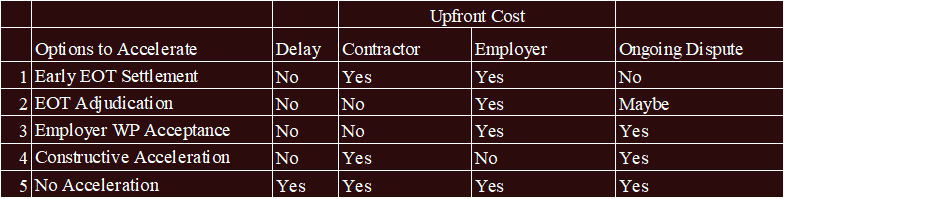
Early EOT Settlement: Parties use principled negotiation to focus on mutual goals as soon as possible and agree an EOT and share the cost burden of implementing acceleration measures;
EOT Adjudication: In line with the Protocol, the parties immediately commence an adjudication on the delay liability. It is suggested that, this option will only be effective with the pre-conditions that the losing party: (i) pays the costs of acceleration measures; and (ii) ideally, accepts the adjudicator’s decision as final;
Employer Without Prejudice Acceptance: An employer might accept costs on a without prejudice basis which will incentivise the Contractor to proceed with the acceleration measures in the interim;
Constructive Acceleration: The corollary to the ‘Employer Without Prejudice Acceptance’. Here, the Contractor claims it was forced to accelerate and attempts to recover damages in proceedings (Note. although constructive acceleration is not recognised in English law, there is a possibility to recover reasonable mitigation costs following breach, as per the Protocol and Motherwell Bridge Construction Ltd v Micafil Vakuumtechnik [2002] EWCA Civ 1579);
No Acceleration: the worst-case scenario, project overruns and legal battles.
Strategic Framework
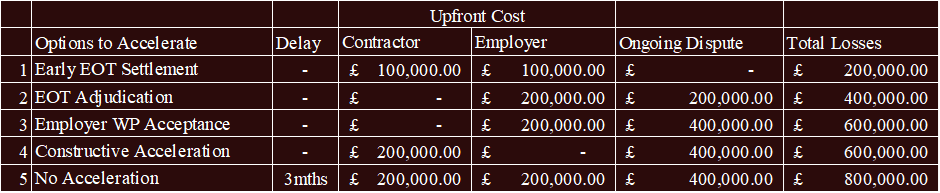
The following tables demonstrate the consequences of these options and it is suggested that these should be considered strategically when parties are facing a live delay dispute:
Acceleration Framework
Worked Example – 3 Month Delay
Overcoming the Stalemate
Unsurprisingly, just like the ‘Prisoner’s Dilemma’, this analysis suggests that the optimal outcome on a time-pressured project is for the parties to co-operate and reach an expedited agreement via Options 1 or 2—with any other outcome proving significantly more harmful.
Firstly, parties should establish a strict deadline for fixing a new Completion Date and implementing acceleration measures. Only if acrimony and entrenchment have taken firm hold with parties unable to settle expeditiously, parties should follow the Protocol and commence adjudication immediately. Pending that outcome, the financial burden of the acceleration measures will be clearly allocated.
Prevention as a Cure
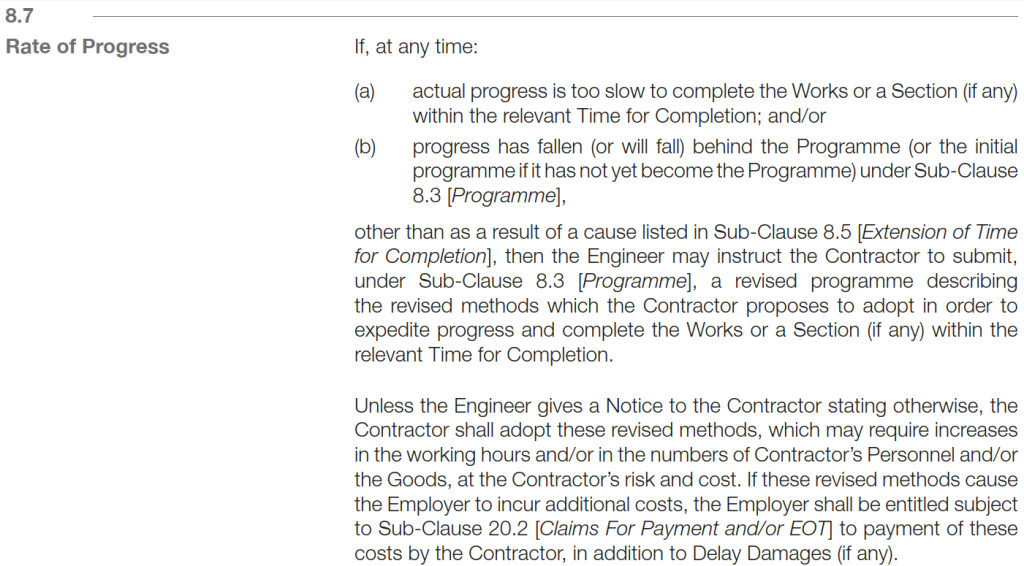
As much as this framework may provide an opportunity to avoid any stalemate persisting, prevention is the best cure and standard form contracts like JCT and NEC need to consider allocating this risk more appropriately. Although not widely used, FIDIC Contracts provide an express obligation on the Contractor to proceed with acceleration measures, unconditional as to who is liable for the delay. By including an equivalent provision to the 2017 FIDIC Clause 8.7, ‘Rate of Progress’, perhaps the issue disappears:
 using WordPress and